
Acworth Directory Collections by Year
Acworth's printed trail is a set of snapshots, not an annual run. The earliest located volume combines Marietta, Acworth, and a general Cobb County directory. Mid-century evidence comes from a short telephone book, while later regional volumes fold Acworth into a wider Marietta and Smyrna series. Each format answers a different question. The oldest book is strong on named trades, firms, churches, officials, and mail recipients. Telephone books favor subscribers. The later residential editions add alphabetical household listings and a street-and-avenue guide that can be read in reverse.
| Collection | Years | Where Held | Access |
|---|---|---|---|
| Gardner Marietta and Acworth directory | 1883-1884 | Switzer Georgia Room and Digital Library of Georgia | Free scan and local research |
| Southern Bell Acworth/Woodstock telephone book | 1949 | Digital Library of Georgia | Free scan |
| Marietta/Smyrna regional residential editions | 1968, 1969, 1970, 1977 | DLG and Switzer Georgia Room | Digital and local holdings |
| Southern Bell Acworth white pages | February 1973 | Library of Congress telephone holdings | Digitized scan |
The confirmed years should not be stretched into assumed coverage. No complete yearly run or final printed year was established. Georgia city-directory databases may span far broader dates statewide, but Acworth editions must be checked one by one. Begin with the digitized 1883-84 Gardner volume, then use the holding institution and catalog records to bridge the gaps.
The source image below shows the official DLG record used for the earliest confirmed Acworth city directory.
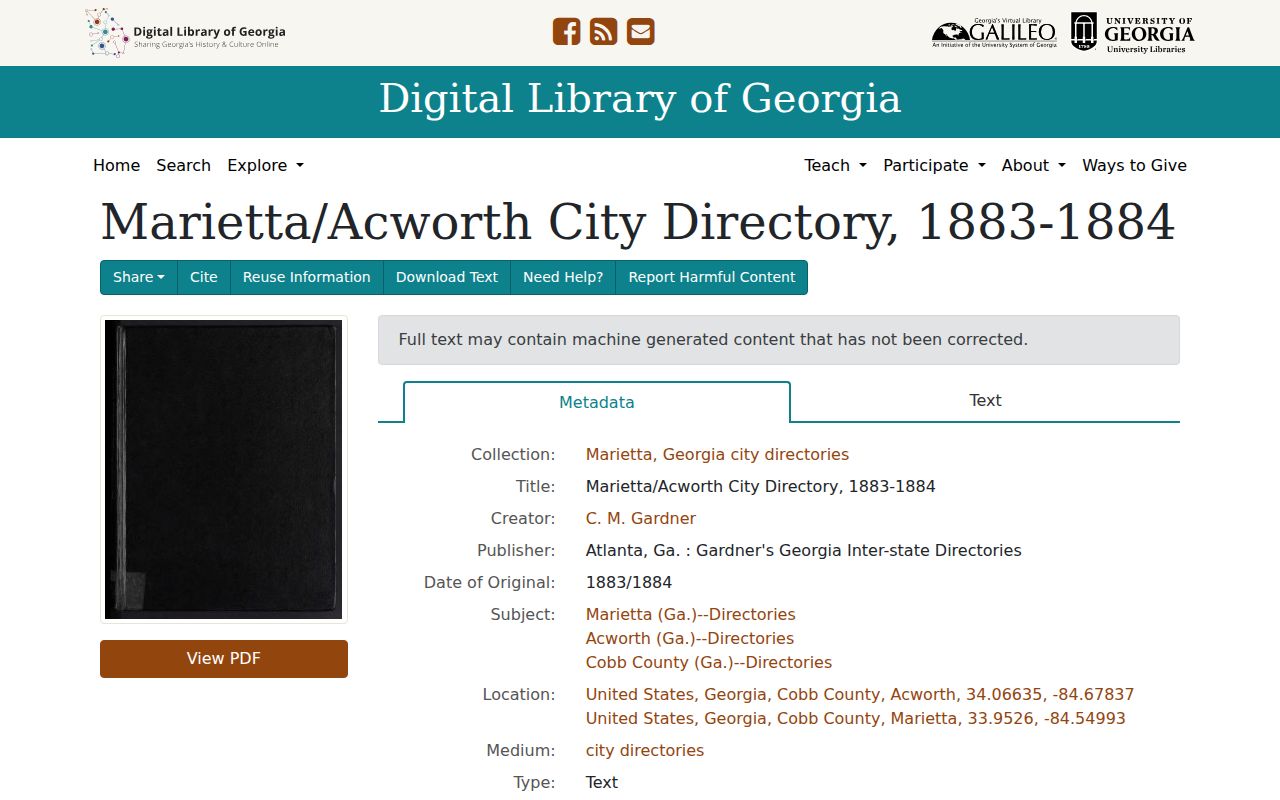
Its catalog context confirms the title, Acworth scope, publisher, and online access before a researcher begins reading names.
Acworth Directories Change Their Scope
C. M. Gardner described the 1883-84 work as a compendium of Marietta, Acworth, and Cobb County. Acworth content mixes town narrative, advertisements, community names, businesses, churches, doctors, ministers, merchants, and other trades. It does not behave like a modern household database. A name may appear in prose or an advertisement rather than in a neat alphabetical line. The publisher also acknowledged that minor errors were possible.
By 1949, Southern Bell's Acworth and Woodstock book recorded telephone subscribers. Its Acworth portion is only 15 pages, a useful warning about completeness. People without telephone service, minors, and relatives without separate listings can be absent even when they lived locally. The regional Atlanta City Directory Co. editions from 1968 through 1970 and 1977 are fuller address tools because their residential listings work with a reverse street guide.
Note: A missing name may reflect the publication's scope or an OCR miss, not a proven absence from Acworth.
Read an Acworth Directory Listing
The 1949 book supplies a clear lesson in local syntax. The letter r marks a residence, as in the inspected pattern “Gorham W Odell r 209 Maple Dr.” Titles such as Mrs, Miss, Rev, Dr, Jr, and Sr can help distinguish people. A doctor's office and home may be listed separately. Businesses carry trade descriptions, while some addresses name only a street, highway, road, mill village, or locality. Short telephone exchanges also reflect the era.
| Name and title | Spelling, initials, honorifics, and suffixes that help separate namesakes. |
|---|---|
| Work clue | An office, trade, business description, or employer when the edition includes it. |
| Residence | A numbered address, street, road, highway, mill village, or locality after the “r” mark. |
| Telephone | A period exchange and number; an asterisk can identify a private branch exchange. |
| Edition context | The abbreviation key, page heading, advertisements, and whether the volume lists subscribers or householders. |
- Criss-cross directory
- A reverse section arranged by street and house number instead of by surname.
- Householder index
- An alphabetical list centered on the named person associated with a household, not a full census of everyone there.
- Abbreviation key
- The publisher's guide to short marks, titles, and terms. Read it before interpreting an entry.
DLG warns that its OCR is machine-generated and uncorrected. Search results are leads. Always inspect the page image, especially where ads, narrow columns, faint print, or old type can scramble a surname. Comparing two digital manifestations can also solve an unclear line in the Gardner book.
Acworth Research at Switzer
The Charles D. Switzer Public Library Georgia Room is the main local-history workspace for Cobb material. It is at 266 Roswell Street in Marietta and can be reached at (770) 528-2320. The Switzer holding-institution record documents its genealogy and local-history strength. The broader Cobb County Public Library gateway supports catalog and location checks before a visit.
Use staff help when a city directory title changes, Acworth is included inside a regional volume, or a year appears under Marietta rather than the city name. Bring the exact surname, date range, address variant, and known trade. Ask about the printed directory, telephone-book, oral-history, newspaper, and genealogy holdings that fit those facts. In-person work can also reveal indexes and companion volumes that are hard to infer from a web result.
The library screenshot below links to the official Cobb library research gateway.
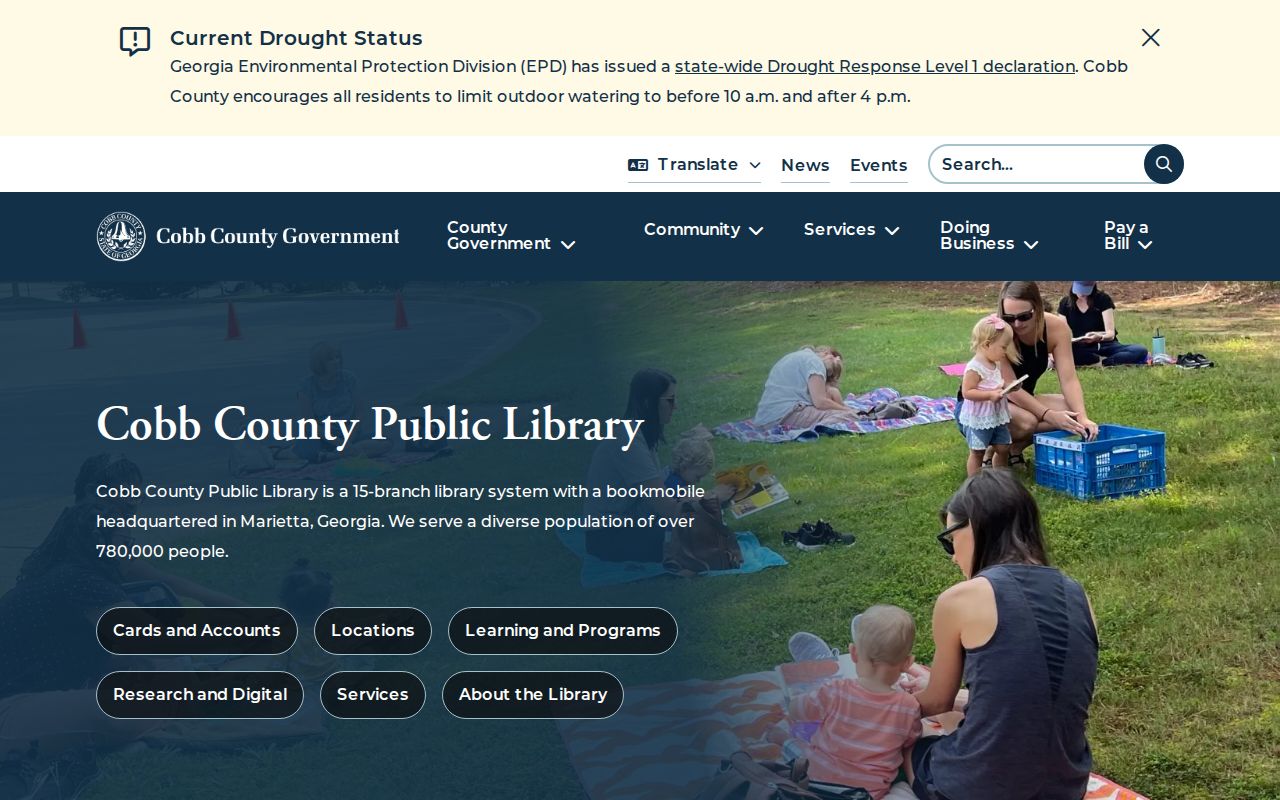
Use that gateway to confirm current access and then contact the Georgia Room for shelf-level help.
Map Acworth Directory Addresses
The January 1930 Acworth Sanborn fire-insurance map has three sheets. It is the only authoritative Acworth Sanborn edition located in the research. The Library of Congress record can connect a directory address to a building footprint, use, construction details, house or block number, and water or fire context. It is a precise bridge, not proof of a continuous map series.
Compare the directory wording with the map before carrying an old number into a modern parcel search. Historic Acworth grew around the Western & Atlantic depot. Its legal limits began as a half-mile radius in 1860 and expanded to one mile in 1870. Main, Center, Lemon, and Collins therefore make sense as a railroad-centered grid, but postal and corporate meanings of “Acworth” changed over time. A legal description and deed chain are safer than an assumed modern number.
Trace Family Through Acworth Directories
Build a family timeline from what each page states, not from what a gap seems to imply. Record the exact name, title, telephone, trade or business, and address. A directory disappearance may signal a move, death, marriage and name change, lost telephone service, or simple omission. The open federal census schedules provide household evidence between editions, and the National Archives applies a 72-year release rule. That makes 1950 the newest open census and a natural partner for the 1949 telephone book.
- Copy the whole entry and its page citation from the chosen edition. Save name variants and titles exactly.
- Move to the next confirmed book in either direction. Note address, telephone, and work changes without guessing why they occurred.
- Use the later street-and-avenue guide to reverse the address and see nearby listings. For current address-led work, use the Acworth street directory workflow.
- Pair the 1883-84 volume with the 1880 census and the 1949 directory with the 1950 census.
- Close gaps with deeds, probate files, obituaries, cemetery records, and the single 1930 Sanborn map.
Georgia Historic Newspapers can supply legal notices, obituaries, weddings, and community news. Georgia Archives' Virtual Vault General Name File is another route, but its surname-letter packets contain roughly 40 to 60 scanned cards and must be browsed. FamilySearch probate images may require a free account or affiliate-library access. These are separate channels, and each can explain a break that the city directory alone cannot.
Acworth Records Survive Unevenly
Cobb County was created in 1832. Georgia Archives marks an 1864 county record-loss event, while Acworth itself was largely burned after Union occupation that year. Neither fact proves that every record vanished. The Archives warns that a courthouse disaster does not mean each book was destroyed. Check its county-card PDF, surviving deed books, local copies, later transcriptions, and directory scans before treating a blank as a historical event.
The confirmed directory timeline resumes with Gardner in 1883-84, Southern Bell in 1949, regional editions from 1968 through 1970 and 1977, and white pages in 1973. DLG digitized the oldest book through a public-library ARPA project and the 1949 volume with LSTA support. Georgia Archives generally has county microfilm through about 1900, sometimes later when a book begins earlier. Later originals stay with Cobb custodians.
Note: Survival must be checked book by book because Acworth's 1864 story does not create a universal records gap.
Acworth Names Gain Living Context
A directory line is terse. Oral histories can restore the community around it. Depot Park History Center, at 4794 S Main Street, is free and open daily from 8 a.m. to 9 p.m. It presents 19 produced history videos, more than 50 long-time-resident oral histories, storyboards, photographs, and Save Acworth History Foundation material.
The KSU Cobb County Oral History Series began in 1978, and bound transcripts are available through KSU Archives and the Georgia Room. Acworth-linked interviews cover the Cobb and Cherokee line, mills, Bell Aircraft, the Lemon family and property, Mars Hill agriculture, mail, schools, churches, and the Black community. Campbell Hill and Fifth Ward place names can sharpen a directory, obituary, church, or census search when a modern neighborhood label is too broad.
The official Depot Park History Center page leads into the local resource shown below.
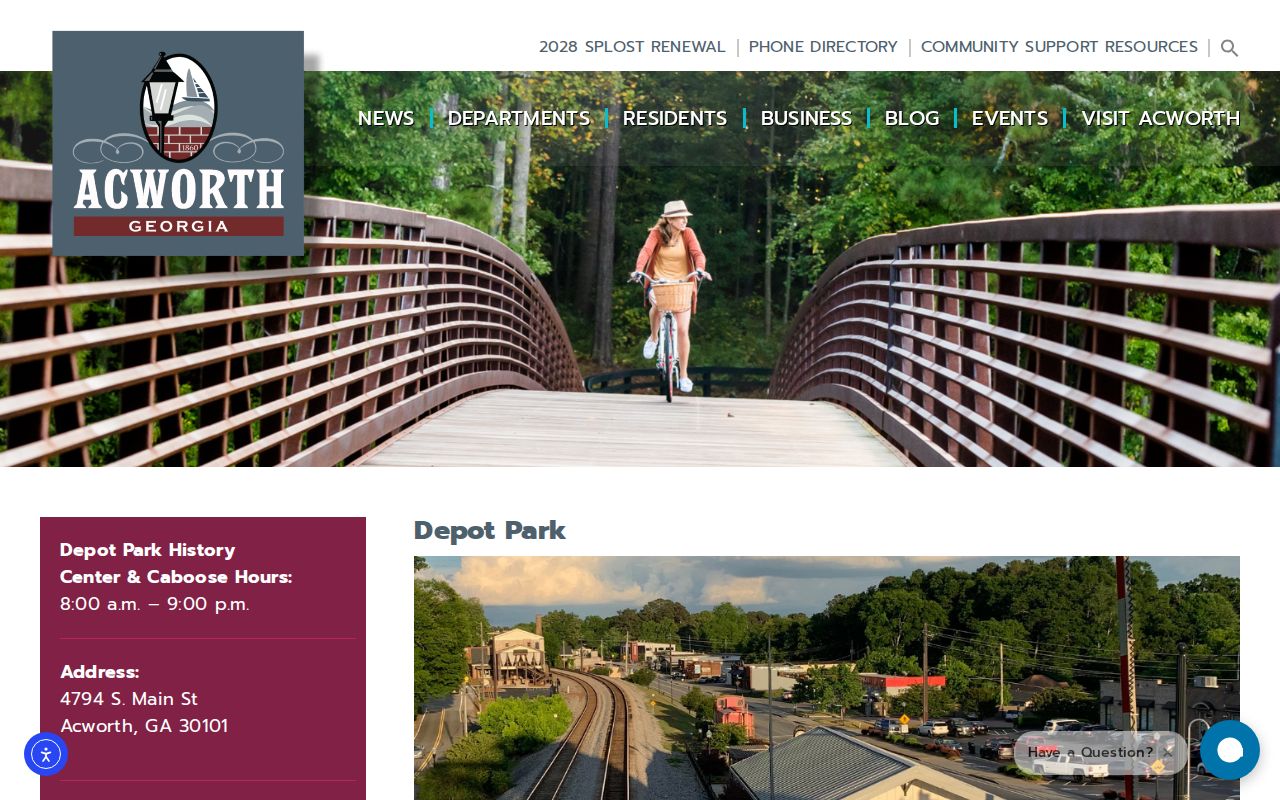
That material can add a voice, workplace, church, road, or family connection to a printed name without changing what the original entry says.